Minneapolis, MN | March 20, 2026
FOR IMMEDIATE RELEASE
NYLC Announces 2026 National Service-Learning Award Recipients Whose Work Is Redefining What’s Possible When Youth Lead
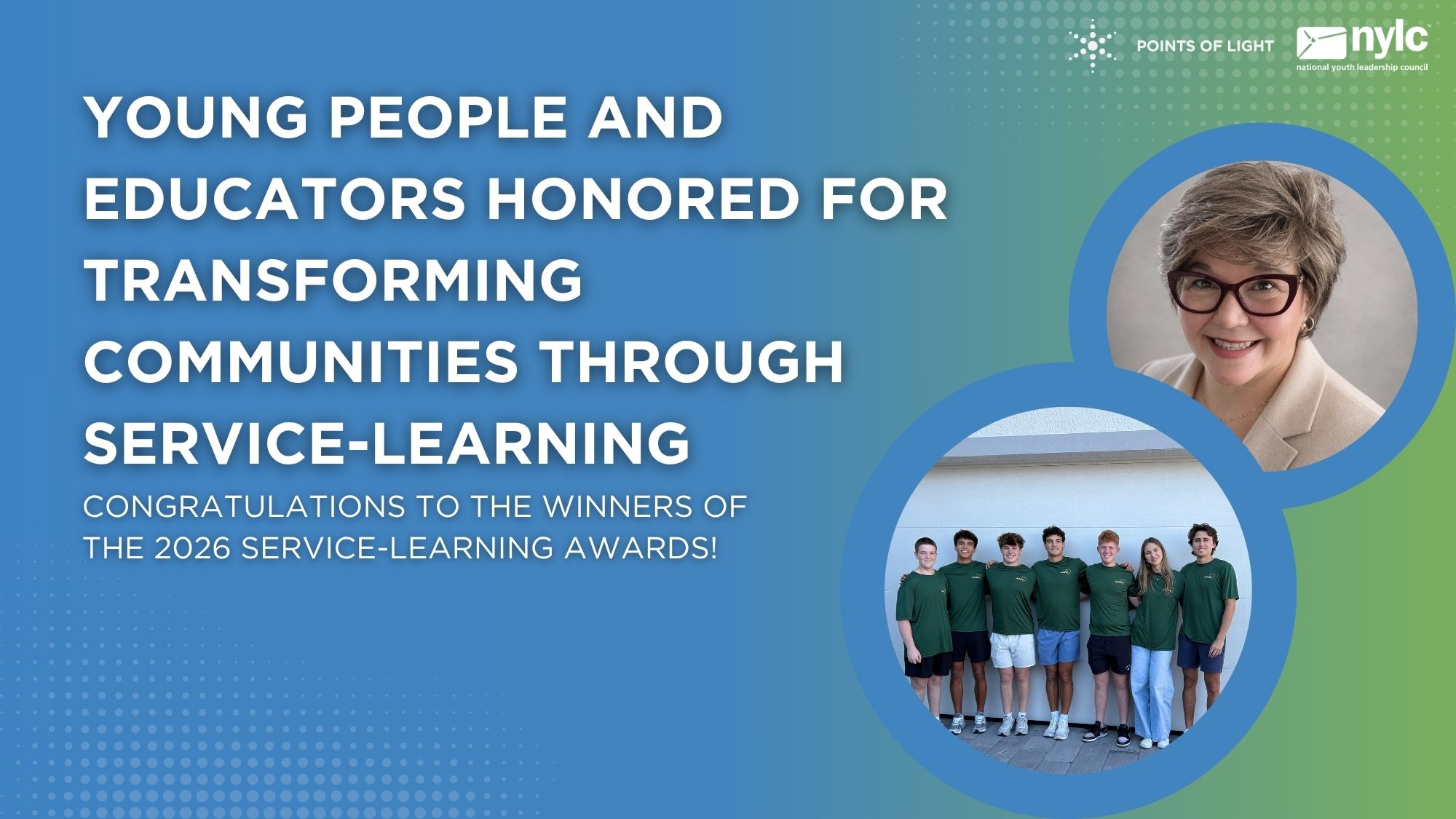
Saint Paul, MN — March 20, 2026 — The National Youth Leadership Council (NYLC) today announced the recipients of its 2026 National Service-Learning Awards honoring a group of extraordinary student leaders in Fort Myers, Florida, and a trailblazing practitioner in Canton, New York, whose work proves that service-learning, done well, changes lives and communities permanently.
These are not participation trophies. They are recognition of young people who looked at a neighbor’s hunger, a community’s language barrier, a county’s unmet needs and decided to act. And of the adult leaders who gave them the tools, the trust, and the space to do it.
“These awardees exemplify what is possible when young people and practitioners are empowered to lead together. Their work reflects the transformative power of service-learning to build stronger, more connected communities.” – Amy Meuers, CEO, National Youth Leadership Council
Youth Leadership for Service-Learning Excellence Award
Tice Elementary Thanksgiving Initiative
Canterbury School — Fort Myers, Florida
When student leaders at Canterbury School in Fort Myers, Florida set out to make Thanksgiving meaningful for their neighbors, they didn’t just plan a food drive. They asked harder questions: What does dignity look like? Who has been left out? How do we build a relationship that lasts beyond one meal?
The answers shaped every detail of what followed.
Canterbury students designed and implemented a comprehensive Thanksgiving initiative at Tice Elementary School, a Title I school serving approximately 500 students in Pre-K through 5th grade. The school is a predominantly Hispanic community facing real challenges, including food insecurity, language barriers, and economic hardship. The goal was not charity. It was connection.
The impact at a glance:
- 500 students in Pre-K through 5th grade received a complete Thanksgiving meal
- Culturally familiar foods centered dignity and cultural awareness
- Spanish-speaking student mentors ensured every family felt seen and included
- A community-wide Turkey Trot united students and mentors in shared celebration
- A lasting school partnership is now planned for future engagement
What made this initiative award-worthy was not its scale although feeding 500 children is no small feat, but its intentionality. Student leaders researched the community before designing the program. They sourced culturally familiar foods. They recruited Spanish-speaking peers to engage directly with families. They wore matching shirts with Tice Elementary students during a school-wide Turkey Trot, a gesture that sounds simple but communicated something profound: “we are not here to help you. We are here with you.”
That distinction is at the heart of NYLC’s vision of service-learning. The students from Canterbury School didn’t perform service. They practiced citizenship.
The initiative has since grown into an ongoing partnership with future programming already in development which is a testament to what is possible when young people are trusted as co-creators, not just volunteers.
About the team:

AACE (Athletes Activating Champions and Empowerment) is a student-led nonprofit founded in Fort Myers with a twofold mission: to help young people realize they have the power to become leaders, and to empower those leaders to serve others in meaningful and lasting ways. AACE provides on site, consistent mentorship to vulnerable youth, combining relationship based support with efforts to meet basic needs. Many of the students we serve come from families facing economic hardship or language barriers, making it difficult to navigate school systems or access resources. AACE becomes a trusted source of guidance, encouragement, and tangible support. Through initiatives such as providing over 500 Thanksgiving meals to every student at Tice Elementary, organizing food drives, and supplying essential items, we help ensure students have what they need both in and out of the classroom. Through our partnership with Valerie’s House, we also support children who have lost a parent or caregiver, offering stability and connection during times of grief. As trust grows, students gain confidence and engagement, while our mentors develop leadership, empathy, and a lifelong commitment to service.
Service-Learning Practitioner Leadership Award
Alexa Backus Chase
Director, St. Lawrence County Youth Bureau — Canton, New York
The Service-Learning Practitioner Leadership Award honors educators and community leaders who don’t just run programs, they build movements. They create systems that outlast any single initiative, and they develop the next generation of practitioners alongside the next generation of leaders.
This year’s recipient, Alexa Backus Chase, has spent more than a decade doing exactly that in St. Lawrence County, New York. This largely rural region is where she has built one of the most comprehensive countywide models of service-learning in the country.
Alexa’s work by the numbers:
- More than 40 youth programs overseen across St. Lawrence County
- Service-learning embedded across schools, nonprofits, and local government
- Issue areas include mental health, food insecurity, environmental stewardship, and civic engagement
- Service-learning principles integrated into county funding strategies and policy
- Teen Ambassador Program equips youth to identify and lead on community challenges
As Director of the St. Lawrence County Youth Bureau, Alexa has done something rare: she has moved service-learning from the margins of education to the center of community infrastructure. Her work doesn’t sit in a single school or a single program. It runs through county policy, funding strategy, nonprofit partnerships, and government initiatives, ensuring that youth voice, reflection, and real-world learning are not extracurriculars but expectations.
Her Teen Ambassador Program is a model worth replicating. Young people don’t wait to be assigned a cause. They identify the challenges facing their communities themselves and lead projects that produce tangible results. The outcomes are measurable. The leadership development is real. And the young people who move through these programs leave not just with skills, but with a sense of agency that follows them into adulthood.
Alexa is also a practitioner’s practitioner. She has mentored educators and youth-serving professionals throughout the region, building capacity that multiplies her impact far beyond what she could accomplish alone. The programs she has built will outlast her tenure. The practitioners she has developed will carry forward the values she has modeled.
That is the definition of a living legacy and it is precisely what this award was created to honor.
About Alexa:

Alexa Backus Chase is the Director of the St. Lawrence County Youth Bureau in Northern New York, where she leads innovative, youth-centered initiatives that empower young people as leaders and changemakers. With over three decades of experience in youth development and education, Alexa has championed service-learning as a powerful strategy to connect youth voice with community impact.
Under her leadership, the Youth Bureau has expanded programs that promote civic engagement, mental health awareness, and safe driving, while elevating youth leadership through initiatives like the Teen Ambassador Program and Lead ’26. Alexa is known for building strong partnerships across schools, government, and community organizations, ensuring that young people are not only heard but are actively shaping the future of their communities.
Her work reflects a deep commitment to the principles of positive youth development, creating meaningful opportunities for youth to lead with purpose, compassion, and resilience.
About the National Youth Leadership Council
The National Youth Leadership Council (NYLC) is the nation’s leading organization in service-learning. Founded in 1983 and headquartered in Saint Paul, Minnesota, NYLC equips young people with the knowledge, skills, and confidence to amplify youth voice and co-create a more just, sustainable, and peaceful world. NYLC advances service-learning, youth voice, and leadership through training, research, standards, and the annual National Service-Learning Conference. Learn more at nylc.org.
Media Contact
Amy Meuers, CEO | [email protected]
National Youth Leadership Council | nylc.org | #SLC26
###